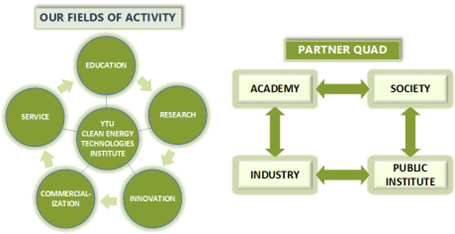
The Institute's fields of activity can be categorized into five main domains: education, research, innovation, commercialization, and services. Within this framework, the areas of activity of the Institute are outlined below:
Providing postgraduate education and training in energy technologies at both national and international levels, with a focus on scientific and applied research, as well as product and project-oriented approaches, while cultivating the expert workforce needed by Türkiye and attracting talent to the country through brain gain initiatives.
Preparing and implementing projects in various categories such as scientific and applied research, development, innovation, and commercialization at both national and international levels, fostering project collaborations, forming working groups for project execution, and establishing and operating necessary shared laboratories.
Establishing collaborations with various national and international scientific organizations, industrial entities, public institutions, non-governmental organizations, municipalities, chambers of commerce and industry, trade exchanges, commercial enterprises, research centers, educational institutions, and institutes in areas such as education, training, research and development, innovation, production, application, commercialization, and consultancy services.
Contributing to Türkiye’s activities in the field of clean energy technologies through infrastructure, projects, and qualified human resources, enhancing the country’s global competitiveness in energy through scientific, technological, and human capital contributions, and providing sustainable solutions to existing and emerging energy challenges while ensuring their implementation and oversight.
Ensuring coordination between existing university laboratories dedicated to clean energy technologies and those to be established within the institute, while developing and sharing regulatory frameworks that guide and unify efforts in clean energy research and applications.
Publishing written and digital periodicals, reports, and strategic plans at both national and international levels in the field of clean energy technologies, organizing certification programs, and hosting courses, seminars, conferences, symposiums, panels, congresses, and other scientific, social, and cultural events, including paid training programs.
Establishing a documentation center focused on clean energy technologies.
Implementing and disseminating sustainable clean energy solutions developed within the Institute across various sectors, including education, industry, tourism, agriculture, healthcare, and the environment.
Establishing a national and international Clean Energy Technologies Advisory Commission within the Institute when necessary.

Fields of Activity
- A+
- A-